
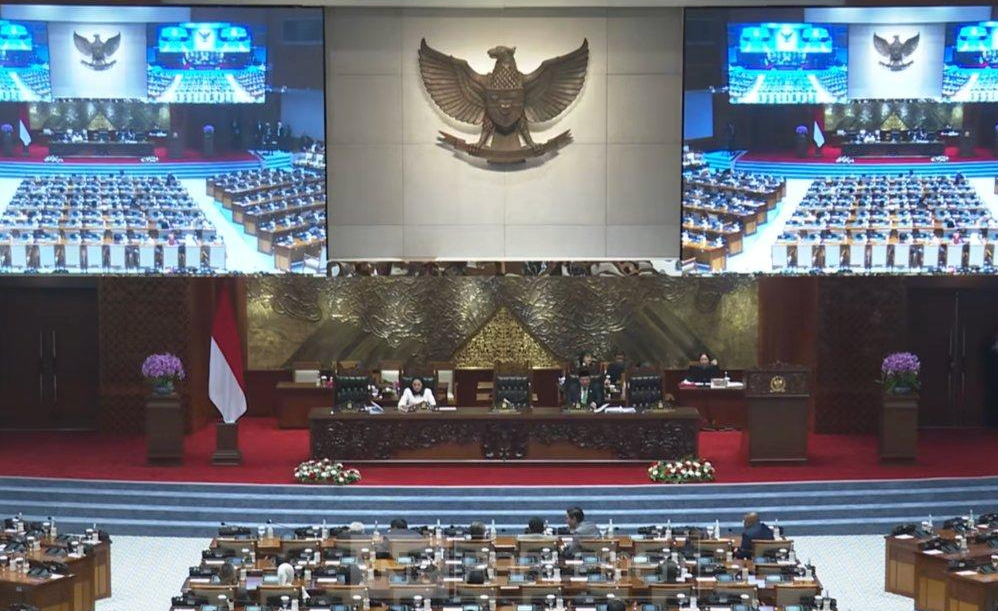
ZOAHARIAN.COM - The news that workers have been waiting for a long time has finally arrived. The Indonesian House of Representatives officially ratified the Employment Protection Bill (RUU) into Law at the 9th Plenary Session for the First Session Period of the 2026-2027 Session Year, Tuesday (6/10/2026).
The meeting, which was held at the DPR RI Building, Senayan, Jakarta, was chaired by the Chair of the DPR RI, Puan Maharani. A total of 326 DPR members were recorded as attending the meeting.
Before ratification, the Chair of the Working Committee (Panja) for the Employment Protection Bill and Deputy Chair of Commission IX of the DPR RI, Putih Sari, submitted a report on the results of the discussion.
Puan then asked for approval from all factions to pass the bill into law.
"Agreed," answered the council members present.
The lady even knocked the gavel as a sign of confirmation.
The atmosphere in the courtroom immediately changed. Elements of workers present on the balcony of the plenary room were heard cheering and clapping to welcome the ratification of the new regulations.
23 Chapters and 313 Articles
The Employment Protection Law consists of 23 chapters and 313 articles. This regulation regulates employment issues broadly, starting from employment opportunities, training, informal sector workers, employment relations, wages, welfare, layoffs to supervision and law enforcement.
The following is an overview of the contents of the law:
1. Equal opportunity and treatment
New rules regulate equal opportunities and treatment in the world of work. This is part of efforts to build a more inclusive employment system.
2. Training and apprenticeships
Increasing worker competency is one part of what is regulated. Job training and apprenticeships are included in a special chapter.
3. Informal sector workers
For the first time, protection of informal sector workers has a special place in the structure of the new law.
4. Work relationships
This law regulates employment relations between workers and employers, including various forms of certain employment relations.
5. Wages and welfare
One of the areas that most concerns workers is wages. The new regulation has a special chapter on protection of wages and welfare.
The aim is, among other things, to encourage a fair and decent wage system while providing legal certainty for workers and employers.
6. Protection during layoffs
Termination of employment (PHK) is also a special part of this law. In addition, there is a chapter regarding severance reserve funds.
This means that the issue of workers' rights when the employment relationship ends is one of the important parts regulated in this regulation.
7. Industrial relations
The relationship between workers, employers and the government is also regulated through a special chapter on industrial relations.
8. Supervision and law enforcement
The law also strengthens aspects of supervision, investigation and criminal provisions in the employment sector.
Thus, the new regulations not only talk about workers' rights, but also mechanisms for monitoring and enforcing rules if violations occur.
Responding to the Changing World of Work
One of the main objectives of drafting the Employment Protection Law is to adapt regulations to changes in the world of work.
Chairperson of Panja Putih Sari said that this regulation is aimed at increasing worker competence and productivity, creating a fair and decent wage system, strengthening industrial relations and anticipating changes in the world of work and digital transformation.
Minister of Manpower Yassierli also stated that the regulation was aimed at strengthening protection not only for workers or laborers, but also job seekers, apprenticeship participants and entrepreneurs.
This ratification also marks a new chapter for the world of Indonesian employment.
For workers, attention is now focused on how all the provisions in the law are implemented in the field. This is because the effectiveness of worker protection will ultimately be determined by implementing regulations, supervision and law enforcement after the law comes into force.
Comment (0)
No comments yet. Be the first!
Leave a Comment